 Ordifyworld
: ORFY Launchpad, Bitcoin Bridging and Wallet Development
- updatedOrdifyworld is the Ordify crypto project focused on early-stage fundraising across Bitcoin-related and Ethereum Virtual Machine (EVM) ecosystems. Its product model combines the ORFY Launchpad with a bridge design and wallet development. ORFY is the project token used for staking-based sale access. An initial decentralized exchange offering (IDO) raises funds through a token sale, with participation governed by eligibility and project-specific terms.
The launchpad organizes fundraising and allocations. The bridge design concerns transfers between token environments, while the wallet focuses on asset management. Each product has its own network scope, access conditions and development history.
Pre-launch fundraising and token distribution
The ORFY Launchpad’s funding model connects projects seeking capital with eligible participants through token sales and allocations before wider trading. Fundraising determines how much a project receives from a sale. Allocation determines each participant’s permitted contribution or token entitlement within that sale. Distribution can follow a project’s vesting schedule after participation. Vesting specifies when tokens become claimable. The allocation limit governs participation, while the release schedule governs later claims. Before an IDO, a snapshot sets each eligible participant’s allocation. The guaranteed round gives eligible participants 24 hours to invest within that limit.
Projects can apply for launchpad listing through a review process. An application starts consideration without establishing acceptance or completed fundraising.
ORFY staking and the earlier points program
ORFY staking connects the token to launchpad eligibility through a points-based tier system. The staking model combines the token amount with a pool multiplier to calculate tier points. A participant’s tier then affects allocation weight. The number of ORFY tokens staked and the size of a later sale allocation describe different quantities. Account verification and the particular IDO’s minimum tier also govern entry.
Longer lock periods carry higher tier multipliers and affect the associated reward terms in the published staking model. A lock period changes the commitment attached to the stake; staking rewards and fundraising allocations describe separate benefits.
Before ORFY went live, Ordify described referral-program points as another path for its own token sale, linking allocations to accumulated participation points during the pre-token period. Its historical scope explains why early points-based launch material differs from the ORFY staking structure.
Bitcoin-related ecosystems and EVM compatibility
Within Ordify’s combined Bitcoin-related and EVM-compatible scope, a project’s token format and blockchain remain separate parts of its fundraising context, with different implications for applications.
BRC-20 and Stacks
BRC-20 uses Ordinals inscriptions to represent fungible tokens on Bitcoin. An inscription records data associated with a satoshi, Bitcoin’s smallest unit. Stacks provides a separate smart-contract environment within the Bitcoin-related scope that Ordify explored. These distinctions affect how applications interpret and use assets. Ordify also discussed Rootstock, Syscoin and Rollux within its broader Bitcoin ecosystem coverage.
Ethereum and other EVM networks
The launchpad’s stated EVM scope includes Ethereum, BNB Smart Chain (BSC), Polygon and Avalanche. A particular sale may apply to only part of that scope. Its accepted contribution network and token-distribution terms determine the relevant chain, without establishing support for every named network in every sale.
How does the ORFY Bridge connect BRC-20 and ERC-20?
The ORFY Bridge design connects BRC-20 assets with Ethereum token representations through Bitcoin indexing, multisignature validation and an Ethereum-side contract. Its intended use extends supported assets into ERC-20 applications.
Bitcoin indexing
Custom indexers interpret Ordinals inscriptions and BRC-20 transfer records. The design adds an Ethereum receiving address to transfer metadata for bridging. That address connects the Bitcoin-side record with the intended recipient on Ethereum.
Multisignature validation
Multisignature validation checks inscription operations before the system updates Ethereum-side state and balances. The design permits adjustments to validation and consensus settings. Those settings form part of the bridge’s security assumptions. The technical description also includes gas-fee deductions and distribution to validators.
Wrapped token creation
The ORFY Bridge design uses an Ethereum factory contract to create wrapped representations of BRC-20 tokens. Wrapped tokens represent the corresponding Bitcoin-side asset in an ERC-20 environment. The design aims to make supported assets usable by lending, staking and vesting applications. Actual use requires support for that representation within the destination application.
Wallet management within the product suite
The ORFY Wallet addresses asset management for Ordinals and Bitcoin ecosystem tokens within the product suite. Wallet development also targeted additional EVM-chain integrations. Ordify listed NFT-platform integration separately in its roadmap, alongside wallet work. These commitments concern different components and do not establish universal NFT compatibility inside the wallet.
Account verification and sale eligibility
Account verification through Blockpass is a prerequisite in the described IDO participation model. Know Your Customer (KYC) checks concern the participant’s identity and eligibility. The minimum staking tier adds a separate requirement, which may differ between sales. Some fundraising events also require registration of interest for the guaranteed round. Country restrictions can exclude affected participants even when an account holds enough staked ORFY. KYC involves submitting personal documents, so a wallet connection alone does not replace those checks or clear country restrictions.
Incubation and cross-network collaborations
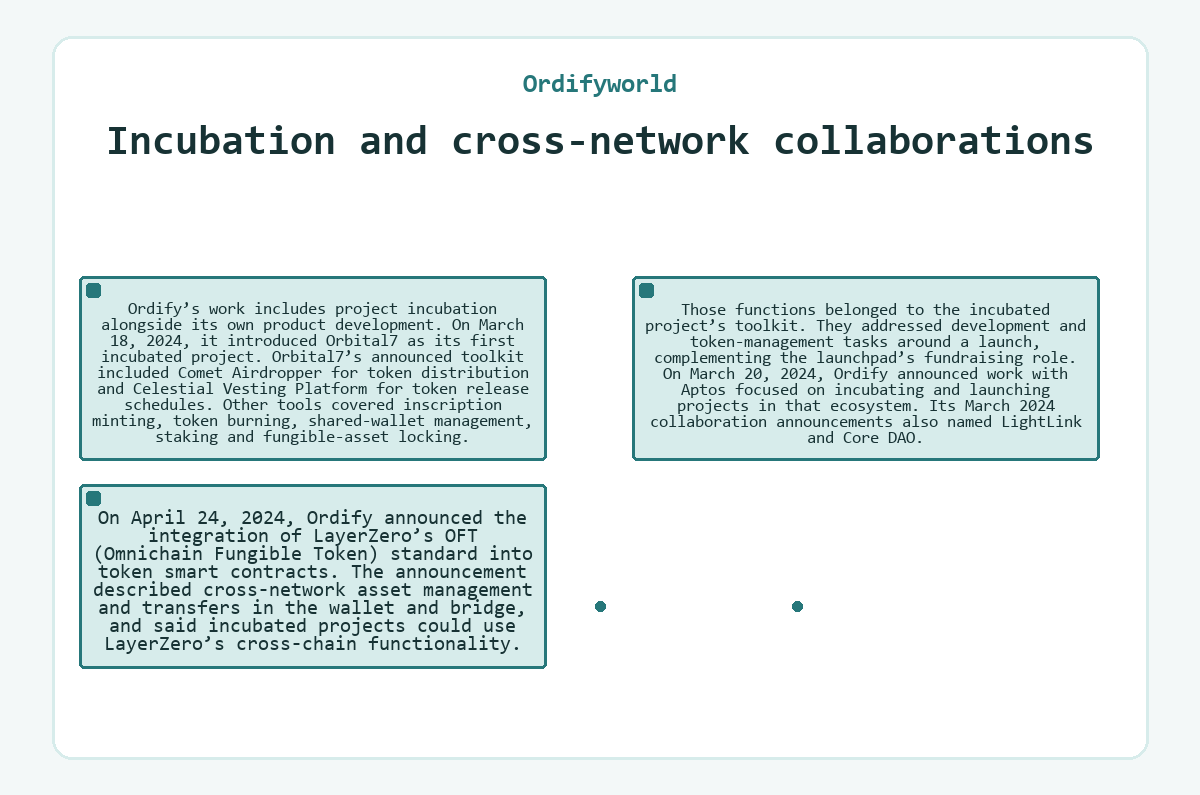
Ordify’s work includes project incubation alongside its own product development. On March 18, 2024, it introduced Orbital7 as its first incubated project. Orbital7’s announced toolkit included Comet Airdropper for token distribution and Celestial Vesting Platform for token release schedules. Other tools covered inscription minting, token burning, shared-wallet management, staking and fungible-asset locking. Those functions belonged to the incubated project’s toolkit. They addressed development and token-management tasks around a launch, complementing the launchpad’s fundraising role.
On March 20, 2024, Ordify announced work with Aptos focused on incubating and launching projects in that ecosystem. Its March 2024 collaboration announcements also named LightLink and Core DAO.
On April 24, 2024, Ordify announced the integration of LayerZero’s OFT (Omnichain Fungible Token) standard into token smart contracts. The announcement described cross-network asset management and transfers in the wallet and bridge, and said incubated projects could use LayerZero’s cross-chain functionality.
Original bridge and wallet development targets
The 2023-2024 roadmap scheduled bridge beta work before wallet alpha and beta testing, giving the components separate development targets. It placed launchpad completion, ORFY staking setup and the token IDO in Q1 2024. Q2 2024 added token-launch and exchange-listing goals. These entries describe the original timetable, which allowed amendments. A target quarter identifies intended scheduling without establishing that the corresponding release shipped.
| Development milestone | Original target quarter |
|---|---|
| ORFY Bridge beta | Q2 2024 |
| Wallet alpha | Q3 2024 |
| ORFY super wallet beta testing | Q4 2024 |
The roadmap targeted Q4 2023 for the ORFY Ventures incubation and venture initiative, with further expansion targeted for Q4 2024. The roadmap also included buybacks and additional chain support. A planned buyback describes a token-related activity separate from sale allocations and staking rewards. These historical targets leave present bridge and wallet availability unresolved.
What limits apply to IDO refunds?
IDO refunds follow separate price-triggered and optional-grace-period provisions. The optional policy depends on the individual project and whether the participant has claimed tokens.
Price-triggered refund provision
The mandatory provision specifies a full refund when a project’s token falls below its IDO price within the first 72 hours. It also states that the project forfeits any distributed tokens. Its scope concerns that sale token and initial window, without establishing protection for ORFY bought elsewhere.
Optional refund windows
Optional refunds apply only when a project offers a grace period. Possible periods are 1, 3 or 7 days; some projects offer none. The period begins with vesting at listing, rather than on the IDO date. Claiming tokens during an optional refund grace period removes refund eligibility under that policy.
After the grace period, participants who requested an optional refund can claim it in USDT on the original investment’s network and page. During the grace period, participants can cancel refund requests and choose to claim tokens instead.
Things people ask about Ordifyworld
What total ORFY supply did the tokenomics plan specify?
The tokenomics plan specified a total supply of 100 million ORFY. It described initial minting on BSC, bridging to ERC-20 and a BRC-20 portion conditional on the bridge becoming live. Total planned supply differs from the amount circulating in markets.
How much time can Blockpass account verification take?
Blockpass verification can take up to 48 hours in some cases within Ordify’s KYC process. The account area displays verification status, with document-review updates arriving by email. This timeframe concerns account verification and does not determine a token sale’s schedule.
Can ORFY be unstaked before a chosen lock period ends?
The December 2023 participation model described early unstaking before maturity, subject to a penalty. The lock period determines the chosen maturity date. Those historical exit terms do not establish whether a current pool offers early withdrawal or how it calculates any penalty.
What happens to tokens left unsold after the guaranteed round?
If tokens remain after the guaranteed round, the fundraising model provides a one-hour first-come-first-served round. Allocation is not guaranteed. Participants who missed required registration may still enter this round if they meet KYC and minimum-tier requirements. In this round, individual allocation limits usually rise by a factor of 3 to 5, but purchases depend on remaining tokens.
How is LayerZero’s OFT integration different from the BRC-20 bridge design?
LayerZero’s OFT integration concerns cross-network behavior in token smart contracts, while the BRC-20 bridge design describes Bitcoin inscription indexing and Ethereum wrapped-token creation. Ordify announced OFT integration in April 2024. That announcement does not specify how it changes the bridge’s multisignature validation model.
Did referral points apply to other sales before ORFY launched?
The pre-token referral program could also cover additional launchpad sales held before ORFY went live, if Ordify chose to run them. Allocations in that extension depended on accumulated points. This condition belongs to the pre-token program and does not establish referral-based eligibility for every later sale.